Winter in Cold Places A winter unit study Ages 4–7
Bare Trees
$5.99 · One-time purchase
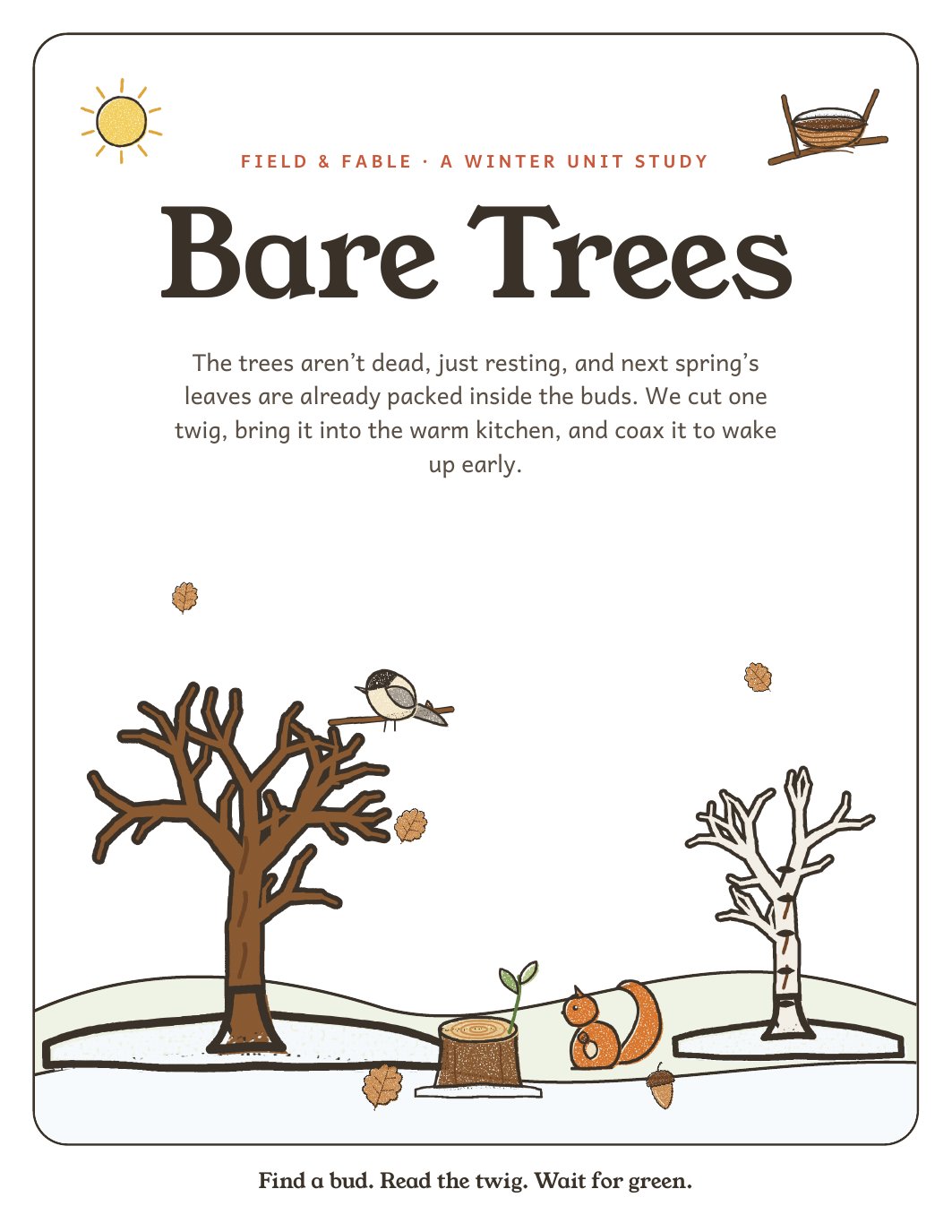
The trees aren’t dead, just resting, and next spring’s leaves are already packed inside the buds. We cut one twig, bring it into the warm kitchen, and coax it to wake up early.
Page four
The four books
Read them aloud in any order, and read a favorite twice. If your library doesn’t have one of these, another good book on the same subject works just as well.
- Winter Trees — Carole Gerber
- A Tree for All Seasons — Robin Bernard
- Tell Me, Tree — Gail Gibbons
- A Tree Is Nice — Janice May Udry
The books aren’t included. Most libraries have them.
Page six
The science lesson
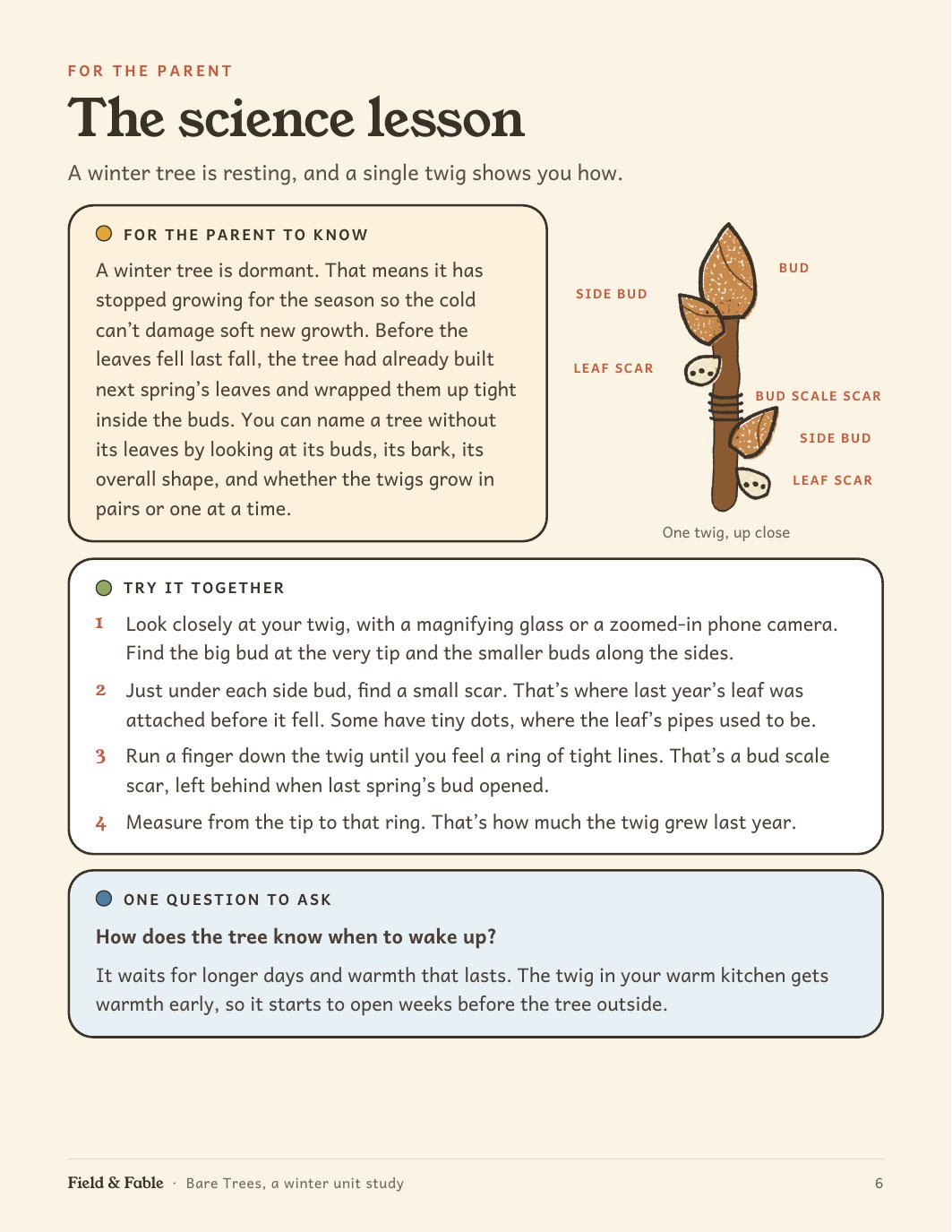
A winter tree is resting, and a single twig shows you how.
A winter tree is dormant. That means it has stopped growing for the season so the cold can’t damage soft new growth.
It starts with what the grown-up needs to know, in plain words. Then there’s something to try together at the table, and one question to ask afterward.
“How does the tree know when to wake up?”
And the rest of the week
- The poems
- One short poem to learn by heart (Joyce Kilmer, from “Trees”) and one to enjoy hearing (Sara Coleridge, “Trees”).
- The activity
- Wake a branch early. Forsythia, apple, cherry, willow, and birch often wake up indoors.
- The craft
- Bark rubbings. Each kind of tree has its own bark pattern, and rubbings make those differences easy to see.
- Math
- Two pages: “Counting buds” and “Waiting days.”
- The copywork page
- Three sizes to choose from, from the single word “bud” up to “I think that I shall never see” Practice makes progress.
- Outside
- A page for spending some time outside observing nature, one look a day, with room for a word, a number, or a tiny drawing.
- A devotion, five days
- A verse, a sentence, and a “Thank you God for ___,” line each day. Job 14:7 · Isaiah 11:1 · Mark 13:28 · Isaiah 55:12 · Psalm 1:3. The verse to learn this week is Psalm 1:3.
- Chocolate bark
- A thin sheet of chocolate scattered with seeds and nuts, then cracked into pieces. It’s called bark because that’s just what it looks like. No oven needed.
- Coloring pages
- Two simple, hand-drawn pages to color.
- What you will need
- Four books from the library, a printer, and things most homes already have: pruning shears or sharp scissors, two jars of water, a ruler, and a magnifying glass or phone camera, thin paper and crayons, chocolate bark ingredients, and mittens.
Take the Bare Trees unit.
One purchase for the whole unit as a print-ready PDF. No account and no login. Your download is ready as soon as you check out, and it’s yours to print as often as you like for the children in your own house.
Part of a set of six
Winter in Cold Places
$24 · $35.94 bought separately
Bare Trees is one of six units for snowy, cold winters. The set adds Snow, Tracks, Wool and Warmth, The Light Returning, and Sap and Sugaring, one unit for each week of winter. You get six separate PDFs.
Here it is.
All five days of Apples, yours to print. A copy is on its way to your inbox as well — check the spam folder if it isn’t there in a few minutes.
Start with Monday: cut an apple across the middle instead of down through the stem, and look for the star.