Winter in Warm Places A winter unit study Ages 4–7
The Winter Harvest
$5.99 · One-time purchase
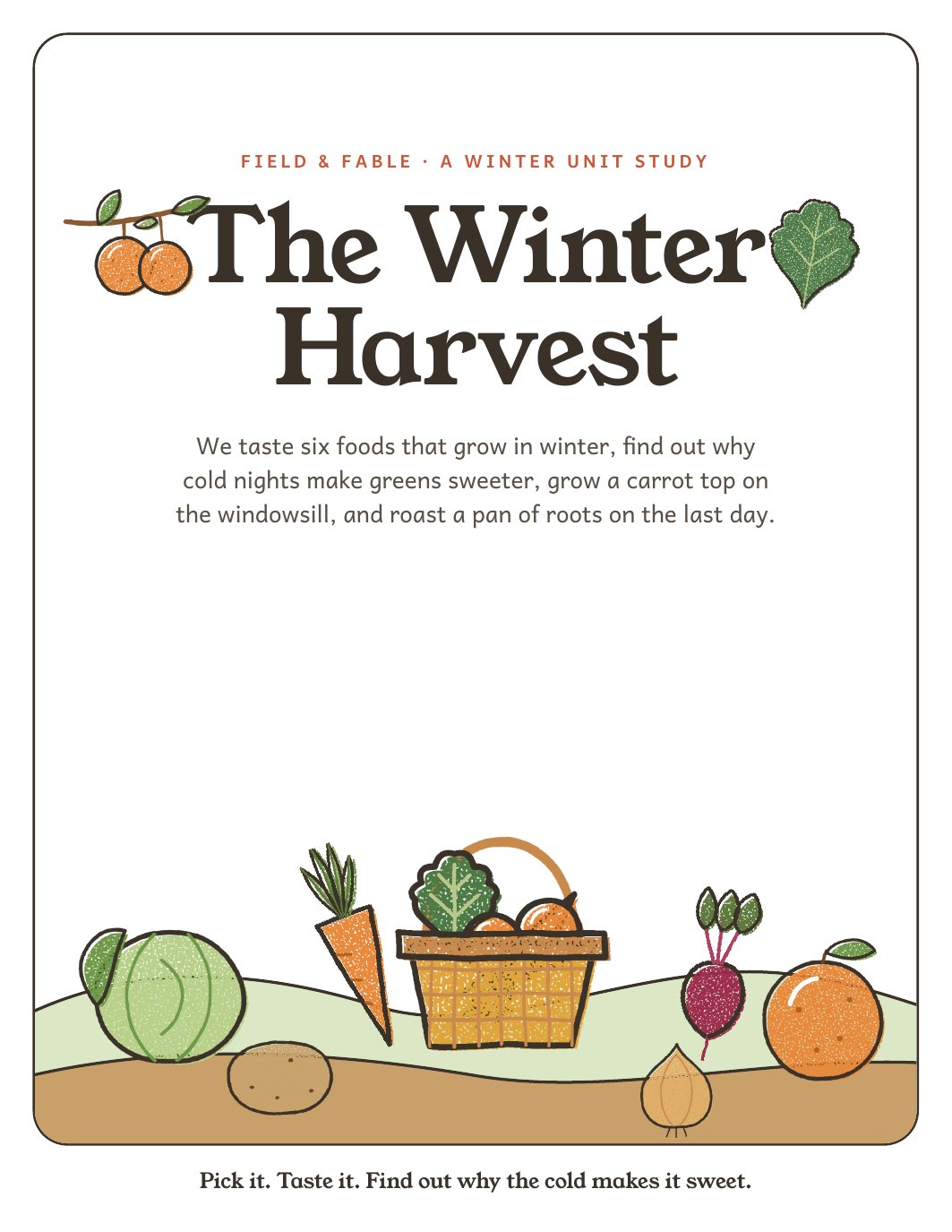
We taste six foods that grow in winter, find out why cold nights make greens sweeter, grow a carrot top on the windowsill, and roast a pan of roots on the last day.
Page four
The four books
Read them aloud in any order, and read a favorite twice. If your library doesn’t have one of these, another good book on the same subject works just as well.
- Tops and Bottoms — Janet Stevens
- How Did That Get in My Lunchbox? — Chris Butterworth
- The Ugly Vegetables — Grace Lin
- An Orange in January — Dianna Hutts Aston
The books aren’t included. Most libraries have them.
Page six
The science lesson
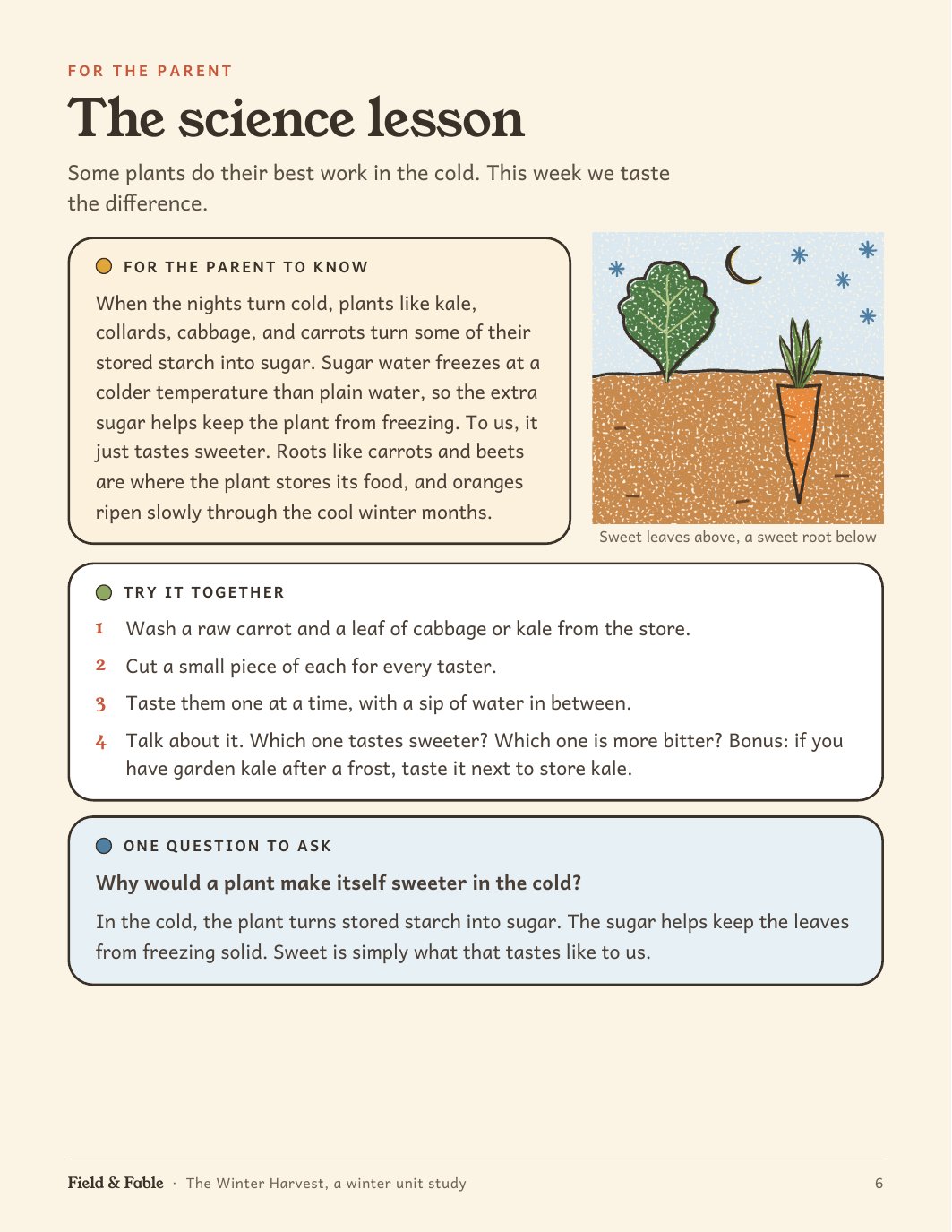
Some plants do their best work in the cold. This week we taste the difference.
When the nights turn cold, plants like kale, collards, cabbage, and carrots turn some of their stored starch into sugar. Sugar water freezes at a colder temperature than plain water, so the extra sugar helps keep the plant from freezing.
It starts with what the grown-up needs to know, in plain words. Then there’s something to try together at the table, and one question to ask afterward.
“Why would a plant make itself sweeter in the cold?”
And the rest of the week
- The poems
- One short poem to learn by heart (Kate Louise Brown) and one to enjoy hearing (Robert Louis Stevenson).
- The activity
- The tasting table. Tasting a food more than once is how kids learn to like it, and scoring it gives them a real job to do.
- The craft
- Grow a carrot top. The carrot top won’t grow a new carrot, but the stored food in it is enough to push out new green leaves.
- Math
- Two pages: “Scoring the six” and “Segments and soup.”
- The copywork page
- Three sizes to choose from, from the single word “root” up to “In the heart of a seed,” Practice makes progress.
- Outside
- A page for spending some time outside observing nature, one look a day, with room for a word, a number, or a tiny drawing.
- A devotion, five days
- A verse, a sentence, and a “Thank you God for ___,” line each day. Genesis 1:29 · Genesis 8:22 · Psalm 65:11 · 1 Timothy 4:4 · Psalm 104:14. The verse to learn this week is Psalm 104:14.
- Roots in the oven, greens in the pan
- One sheet pan and one skillet put the whole winter harvest on the table.
- Coloring pages
- Two simple, hand-drawn pages to color.
- What you will need
- Four books from the library, a printer, and things most homes already have: six winter foods, a basket and scrub brush, a carrot and a saucer, a ruler and oranges, and a sheet pan and a skillet.
Take the Winter Harvest unit.
One purchase for the whole unit as a print-ready PDF. No account and no login. Your download is ready as soon as you check out, and it’s yours to print as often as you like for the children in your own house.
Part of a set of six
Winter in Warm Places
$24 · $35.94 bought separately
The Winter Harvest is one of six units for mild, wet winters. The set adds The Rains, Frost and Dew, The Birds That Came South, The Cold Snap, and The Winter Sky, one unit for each week of winter. You get six separate PDFs.
Here it is.
All five days of Apples, yours to print. A copy is on its way to your inbox as well — check the spam folder if it isn’t there in a few minutes.
Start with Monday: cut an apple across the middle instead of down through the stem, and look for the star.